Austin & Everything After ….
Doing your best is better for you than being the best.
It sounds like something we tell our kids: “All you can do is your best.” It’s something to alleviate the pain of losing or not achieving the top spot—a way to reward them for effort rather than the medal. We should probably listen to those words.
You can give up a lot to try to “win” something; you can give up everything. Excelling at the highest level takes sacrifice. It requires selfishness. The premium spot demands it and devours you. That is the cost of chasing perfection.
But many will tell you of the emptiness they felt the day after the win. You hoped it would be “the thing,” that your cup would be filled and that you would walk away satisfied. So often it’s not the case. It’s a thirst that can never be quenched. So if winning doesn’t satisfy you, then what will?
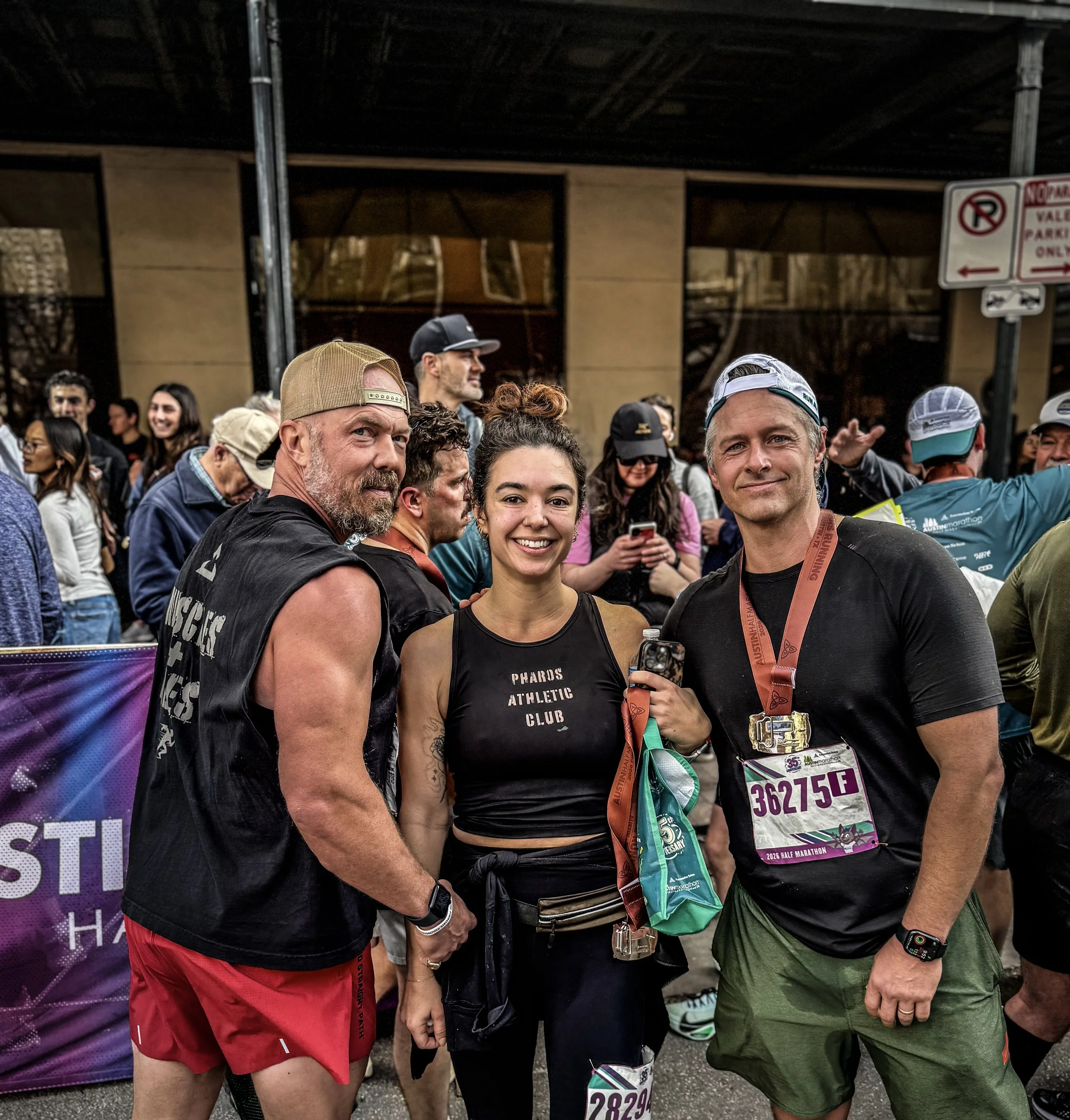
As Eric, Laura, and I sat down after our efforts at the Austin Marathon (Eric did the full, while Laura and I did the half), we reflected on this. None of us signed up to “win,” and though we all trained, none of us felt like we had given up our lives for the cause. It is simply a question of challenging yourself—creating an artificial obstacle for you to navigate and scale—and then feeling a sense of accomplishment when it’s done. There were no “post-race blues” or comedowns, just a sense of fulfilled purpose.
For myself, I had asked the question: “I’m now 47, I’m 208 pounds, I’m not built like a runner, and I don’t consider myself to be ‘a runner.’ Would a sub-1:45 half marathon still be possible?” It was a question I simply did not have the answer to right up until the moment it happened.
I had done most of my running training in the mountains, which meant running 4,000-6,000 ft of elevation on very hilly courses. I had been running with friends who pushed me—friends younger and lighter who were better than me at running. Not once had I held a sub-8-minute mile pace for any considerable length of time.
But it built reps and confidence in conditions harder than the race itself. “Train hard, fight easy,” as the old saying goes. I felt “ready” for the race, but by no means was I sure of the result.
We started the race late. Traffic and a babysitting issue meant I missed my corral. I spent the first 2 miles running past people, feeling like “Herbie Goes Bananas.” I weaved in and out of the slower-paced runners, determined to get back on track and find the pace I should be running at. And then it happened…
I’ve rolled my right foot many times—it’s an old soccer injury that won’t go away. One misstep in the first mile and my foot rolled; I heard a crunch. I knew what I had done, and I knew it was bad. But I also refused to let it define my race. So I hobbled for as long as I had to before adrenaline and obstinance made it numb enough to find my stride. By mile 5, I was averaging a 7:30/mile pace and was on track. My will was greater than my excuse .
If you’ve run a race, you’ll know it’s very different from training. The crowds cheering, the music, the energy of the participants, the goodwill—it gives you an extra gear. My fueling strategy was working perfectly; I felt hydrated and calorically loaded. I was pretty surprised when I checked and saw my average pace around the 7:30/mile mark. I didn’t feel like I had pushed too hard or overexerted myself. I felt good and was gathering faith by the minute that I would hit my goal despite my ankle.
When you run distance, you find yourself just shooting for the next “milestone”: “just get to 5,” “once you get to 7, you are over halfway,” “once you get to 10, it’s just a 3-mile finish,” “when you hit the last mile, just go for it.” You create green lights, positive markers that are within reach. Just accumulate those, and before you know it, the race will be done. Break down the journey into the sum of its digestible parts so that it never feels overwhelming or too much. Add to that fueling markers—I took a gel at 5, 8, and 10 and convinced myself it would boost me. Whether it does or doesn’t, just convince yourself that it does, and you’ll have the edge. Greg lights (hats off to McConaughey).
As marathons go, Austin is considered “hilly.” You definitely notice them when they come, particularly toward the end, but it was nothing as bad as the inclines I’d been used to in the mountains. I felt very prepared for that challenge. I also knew I had the power in my muscles to sprint the last section, and it felt good to finish at pace and push for the line.
My only fear going in was that my hamstrings would cramp. It’s been an issue in the past, but an increase in mobility work, potassium, magnesium, and improved hydration strategies seemed to solve the problem. It felt good to know that I had a problem, acknowledge it, and find a practical solution that worked! I felt I had run the best race I could have, overcome the challenges that were presented to me (foreseeable and unforeseeable), and dealt with it all maturely, strategically, and with a smile on my face. I ran a good race and had fun doing it.
I had been coming to Austin since 2007. I was in a very different time in my life back then—still single, with no kids, less stress, and less responsibility. I was living in England, and Austin was a fantasy land for me—a western fitness party town with a cool soundtrack and good food. It combined many things I loved and had it all in a climate I relished. I immediately felt comfortable there and in love with the scene. Coming back now, years later, as an older man in a very different situation, reminds me of the feelings I had. Much like myself, Austin has grown almost beyond recognition. It has a lot of new stuff, but many would argue that it’s lost some of its local charm as big money and big development came in. But still, to me, it’s special, full of opportunity and goodwill. There’s a reason why so many people have moved there; it has a secret it couldn’t keep quiet.
As I ran, I thought about all of this (that’s the beauty of a long run). What got me here, what it represents, and what I can learn. A wild amount of things have happened since 2007; sometimes it feels like I have lived a few different lives, all of which I’m grateful for. I didn’t come here to win anything. I came here to experience something, to remember something, to find something. And I did.
You know what it was? It was realizing that I’m 47 and that my best is still yet to come—not in terms of what I can win, but what I can offer. Because in the end, “what am I really trying to do?” is the only question worth asking. The miles add up, and it can look a lot like wear and tear. But the lines bring wisdom with them. Who you used to be is just you with less experience. I’ve been listening all these years to people’s stories and dreams. I guess I’ve been collecting data in a fashion—data that allows you to console and comfort, information that helps you understand and have compassion, and that perhaps allows you to light a few fires in the eyes of another and fill someone else’s heart with the courage they need. Without an agenda, only with goodwill. Like wine, we can either turn sour or age with depth. I think, I hope, I’ve done the latter. At the very least, that depth is what I’m always striving for. When I thought about it, I realized that the race I was running was just a symbol of the race I have always tried to run—the one where, no matter what, I just do my best.